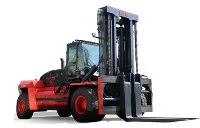
During building material production and construction, the efficiency of loading and unloading concrete blocks, bricks, and various precast components affects the overall construction progress and on-site management costs. With rising manual loading and unloading costs and increasingly stringent safety requirements, the handling of raw block materials is gradually shifting from manual labor to mechanization and systematization. In this process, wheeled forklifts, due to their strong adaptability and flexible functionality, are increasingly being regarded as a highly efficient in overseas markets.
I. Changing Operating Environments Drive Upgrades in Loading and Unloading Equipment
Modern block factories and construction sites are mostly open-air environments with complex ground conditions. Gravel roads, unpaved areas, and frequent site changes are common. Traditional forklifts rely on flat ground and are generally unable to operate smoothly in these environments. In contrast, wheeled forklifts, with their thick tires and higher chassis design, offer excellent passability and stability, allowing them to operate continuously in complex conditions.
Therefore, in block yards and loading areas, a single wheeled forklift can often handle multiple loading and unloading tasks, becoming the core block loading machine on site.
II. Multiple Attachments to Meet Diverse Loading and Unloading Needs
Another advantage of wheeled forklifts lies in their excellent adaptability. With standard forks, they can handle large materials; by changing attachments such as clamps, side-shifters, and buckets, they can handle loading and unloading needs for materials of different sizes and shapes.
This "one machine, many uses" characteristic means that in practical applications, wheeled forklifts are no longer limited to a single handling function, improving overall equipment utilization. This is one of the important reasons why wheeled forklifts are classified as multi-functional block loading machines.
III. Stability and Safety in Heavy Block Operations
Blocks are typically quite heavy, requiring higher equipment stability. Wheeled forklifts are designed with heavy-duty conditions in mind, and through reasonable wheelbase and weight distribution, effectively improve stability during loading and unloading.
Meanwhile, the hydraulic system offers excellent controllability during lifting and lowering, reducing material swaying and helping to lower block breakage rates and operational safety risks. These features give it the advantage of long-term stable operation in heavy block handling scenarios, further strengthening its application positioning as a Block Loading Machine.
From the perspective of actual use, wheeled forklifts are no longer just simple handling equipment, but are gradually developing into a professional Block Loading Machine worthy of attention in the building materials industry.